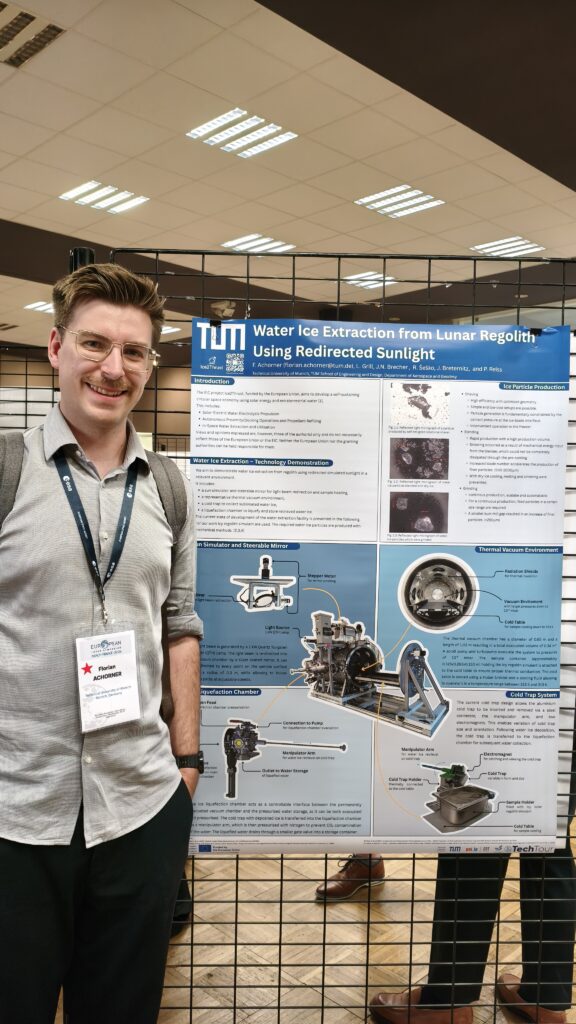
On the picture: Florian Achorner (Technical University of Munich) presenting the Ice2Thrust poster at the European Lunar Symposium 2026, Nancy, France.
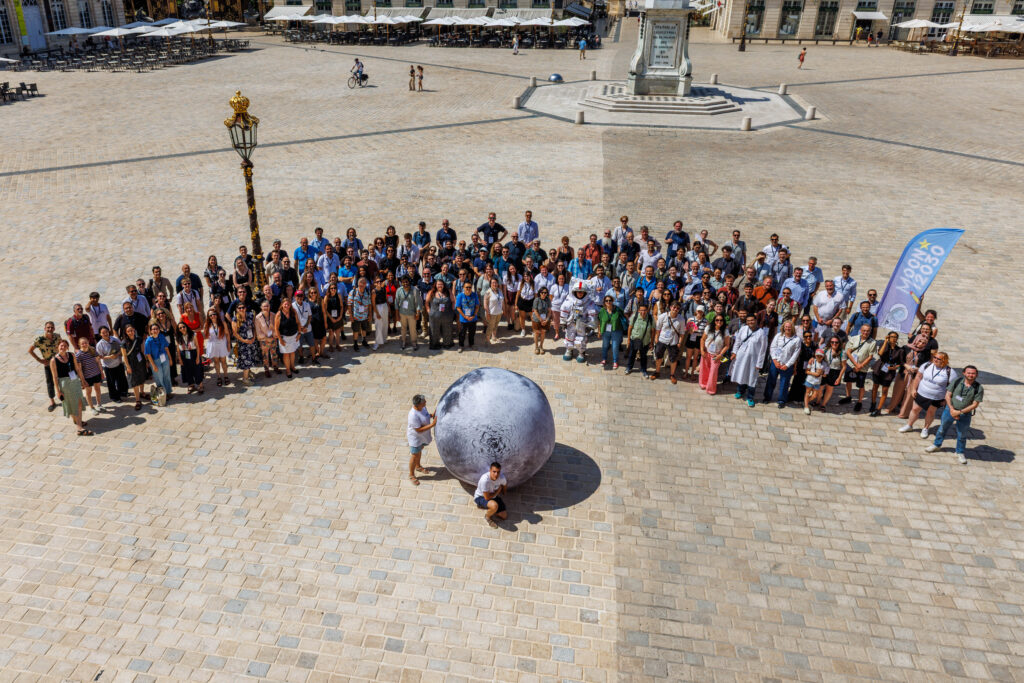
Nancy, 21-26 June 2026 —The Ice2Thrust (S4I2T) consortium was represented at the European Lunar Symposium (ELS) 2026, held from 21–26 June at the Muséum-Aquarium de Nancy in Nancy, France. One of Europe’s premier gatherings for lunar science and exploration, ELS brings together around 200 researchers, engineers, and professionals each year to present the latest results, forge new collaborations, and shape Europe’s role in the future of lunar exploration.
About the European Lunar Symposium
Hosted in a different European city each year and supported by NASA’s Solar System Exploration Research Virtual Institute (SSERVI) and the European Space Agency (ESA), ELS spans the full breadth of lunar science — from the origin and evolution of the lunar crust to regolith physics, the polar environment, and the water ice deposits that will underpin future surface operations and in-situ resource utilisation (ISRU). It is precisely the community whose research sits upstream of the Ice2Thrust mission.
Ice2Thrust at the Poster Session
The project was represented by Florian Achorner, researcher at the Technical University of Munich (TUM), with a poster titled “Water Ice Extraction from Icy Lunar Regolith Simulants Using Redirected Sunlight.” Developed together with co-authors L. Grill, J. N. Brecher, R. Šeško, J. Breternitz, and P. Reiss, the work demonstrates how redirected sunlight can be used to sublimate water ice from icy regolith simulants in a representative thermal-vacuum environment, capture it in a cold trap, and liquefy it for storage.
The abstract is available on Zenodo: https://doi.org/10.5281/zenodo.20383450
Why This Matters for Ice2Thrust
Water extraction is the first link in the chain Ice2Thrust is building. S4I2T — funded under the EU’s Horizon Europe EIC Pathfinder programme — is developing an end-to-end technology chain for in-space resource utilisation: converting water ice extracted from planetary bodies into green propellant through solar-powered water electrolysis, and ultimately generating thrust. Demonstrating reliable water extraction from lunar regolith is a foundational step towards a self-sustaining, water-based space economy.
Engaging directly with the lunar science community at events like ELS is a key part of how the consortium — led by TUM and involving EnduroSat, the University of Luxembourg, Tech Tour Global, and Tech Tour Europe — disseminates its results and builds the network of stakeholders who will help shape the adoption of next-generation, sustainable propulsion.