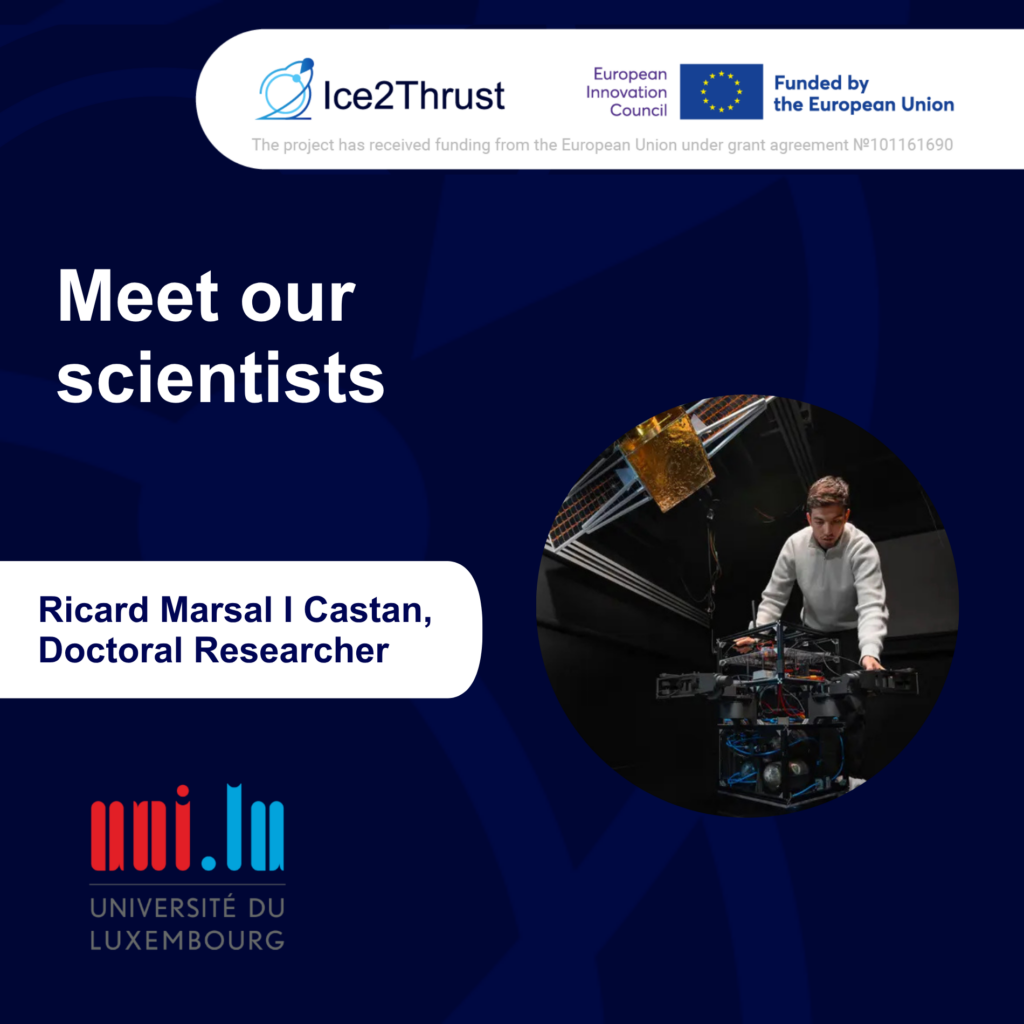
On the picture: Ricard Marsal i Castán, PhD Researcher, University of Luxembourg Space Robotics Laboratory (SpaceR), Contributor to Ice2Thrust.Space (S4I2T).
Ice2Thrust.Space is proud to spotlight Ricard Marsal I Castan, PhD candidate at the University of Luxembourg’s Space Robotics Laboratory (SpaceR), whose work on autonomous space robotics is helping close the gap between intelligent simulation and reliable real-world performance.
Ricard has always been driven by a need to understand how intelligent systems adapt and learn in complex physical environments. That instinct led him to degrees in mathematics and computer science, followed by a Master’s in System Design and Information System Engineering. Before joining academia full-time, he worked as an engineer and researcher across institutions including Incubit and the National Institute of Informatics in Japan — experiences that sharpened both his theoretical grounding and his desire to see algorithms leave the lab and operate in the real world.
Today, as a PhD candidate at SpaceR, his research focuses on robust multi-task reinforcement learning and hypernetworks for autonomous space robotics. His work spans the full development pipeline: building simulation frameworks, designing zero-gravity satellite emulators, and deploying ROS 2 stacks on physical hardware. Throughout, his goal remains the same — to bridge the gap between simulation and reality.
The defining challenge in this field is ensuring that data-driven algorithms perform reliably when transferred from virtual environments to unstructured real-world conditions. It is a problem that sits at the heart of making autonomous spacecraft trustworthy enough to handle complex in-orbit tasks without human intervention.
Within Ice2Thrust, Ricard’s work contributes directly to the autonomous proximity operations and docking capabilities that make in-orbit refuelling possible. Looking ahead, he hopes to see adaptive autonomous systems flying routinely — enabling complex in-orbit servicing, debris capture, and truly sustainable space missions to become the norm rather than the exception.
Contact: Ricard Marsal I Castan, PhD Candidate, University of Luxembourg — SpaceR, Contributor to Ice2Thrust.Space (S4I2T), richard.marsal(@)uni.lu